
Out of This World: The Most Iconic Space and NASA Postage Stamps
A guide to the most celebrated space-themed stamps
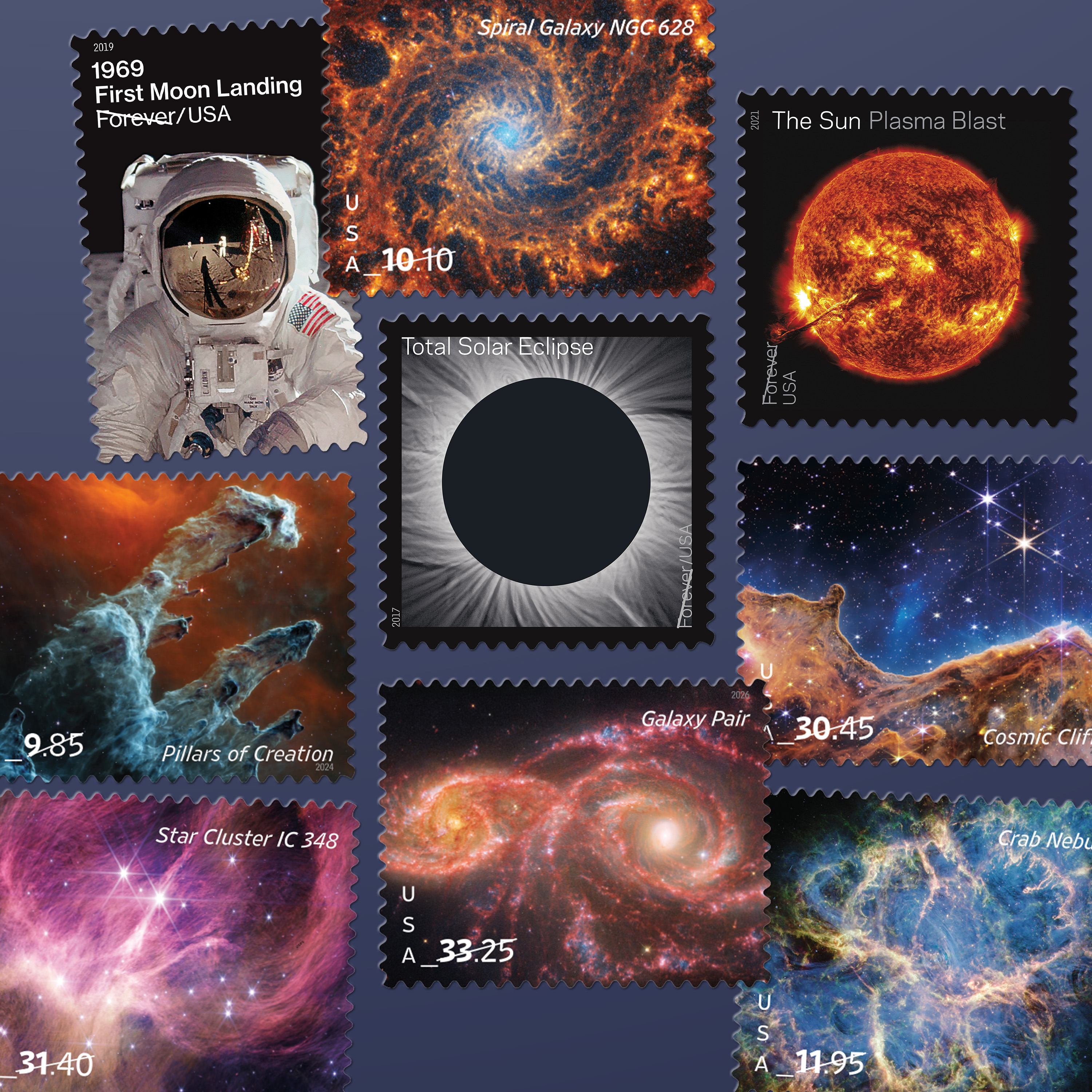
Do you ever need to clear your mind of life’s complications here on Earth? Go out and gaze at the stars on a dark night. Contemplate the vastness of space and the awesome mysteries it holds.
Or let some of our favorite postage stamps transport you with breathtaking views not only of our solar system, but also of regions of the cosmos that are too many light-years away to wrap your mind around.
The artwork on a recent series comes by way of the James Webb Space Telescope, the largest and most sensitive telescope ever deployed in space, now orbiting the Sun about a million miles from Earth.
Launched on December 25, 2021, by NASA in partnership with the European Space Agency, the Canadian Space Agency, and Space Telescope Science Institute (STScI), the Webb telescope is able to capture images using powerful infrared cameras that reveal previously hidden galaxies and stars. Like fog lights through mist, infrared imaging allows scientists to see beyond the surface, capturing heat and radiation outside the visible spectrum.
Just think: Webb’s discoveries are reshaping our knowledge of galaxies, exoplanets, and the formation of stars. You can follow along with these stamps, all designed by USPS art director Greg Breeding. Celebrate space exploration!
Pillars of Creation
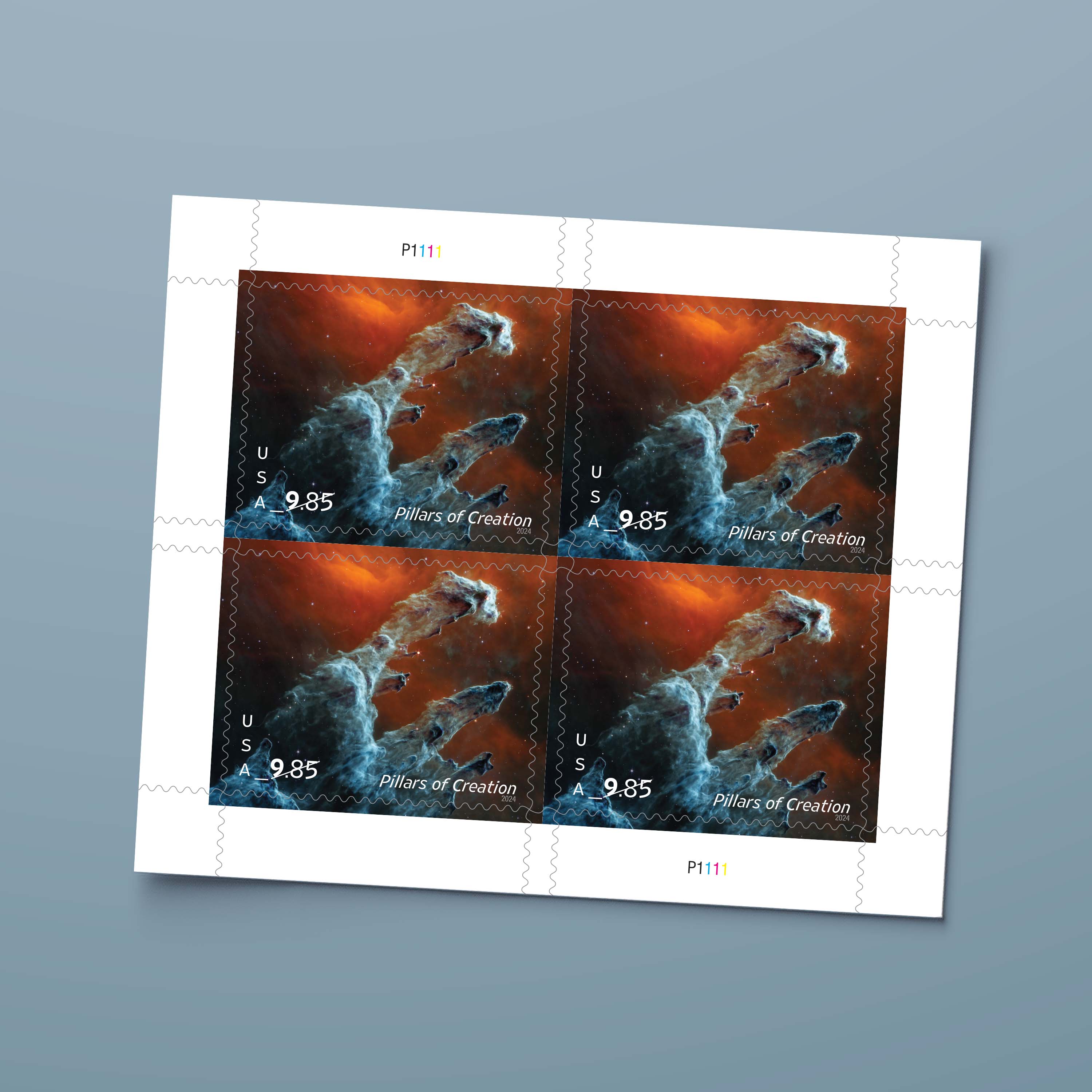
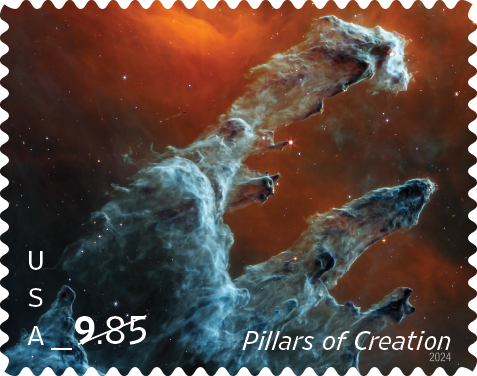
The Pillars of Creation, part of the Eagle Nebula 7,000 light-years from Earth in the Milky Way galaxy, provides clues to the origins of our solar system. A nebula is a huge cloud of gas and cosmic dust, while a galaxy is a gigantic collection of gas and dust, plus billions of stars and their solar systems, all held together by gravity.
Captured in fantastic detail by Webb in 2022, the image on this 2024 Priority Mail® stamp is a digitally colored view of the bands of mid-infrared light emitted by the pillars. By assigning color to various infrared wavelengths, the digitized image allows us to see “landscapes” otherwise invisible to the human eye.
Red areas toward the ends of the pillars show burgeoning stars ejecting raw material as they form, while the relatively small red orbs scattered throughout the image show newly born stars. Some of that same material may coalesce into new planets.
Cosmic Cliffs
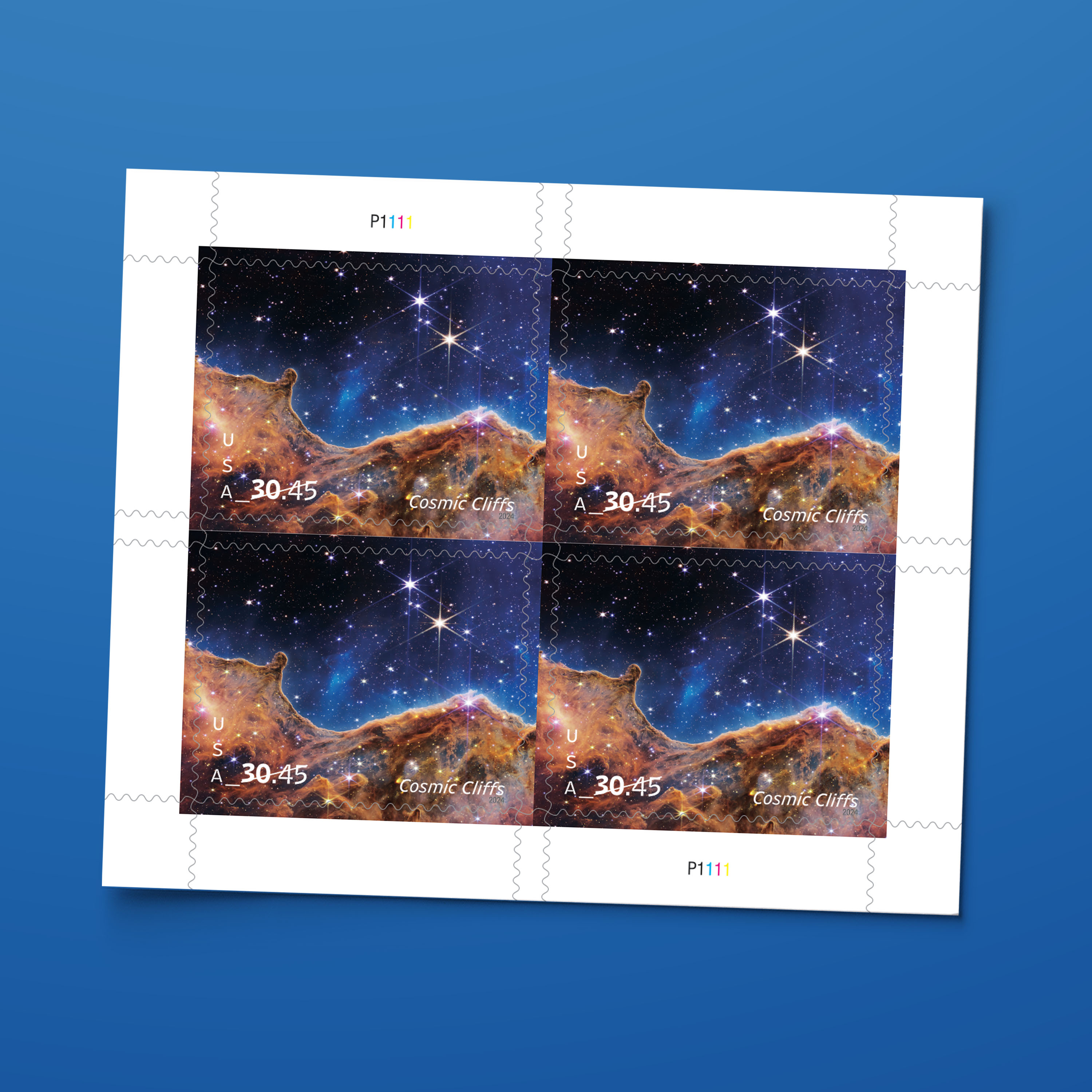
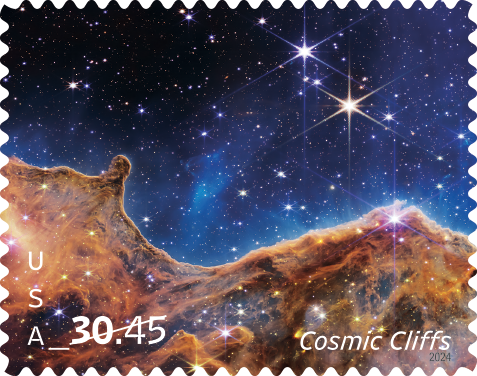
A 2024 Priority Mail Express® stamp features the Cosmic Cliffs, part of the vast Carina Nebula, 7,600 light-years from Earth. Red and yellow flares scattered throughout the cliffs show developing and newly born stars. The orange and brown clouds in the lower third of the image are swirls of dust and gas. Additional stars in our Milky Way, as well as distant galaxies, appear in the blue and black regions above and beyond the nebula.
Radiation and solar winds emitted by newly formed stars blow gases and dust into a frenzy of creation and destruction within the enormous swirl of the Cosmic Cliffs. These particles are the active building blocks of new stars and planets.
Spiral Galaxy NGC 628
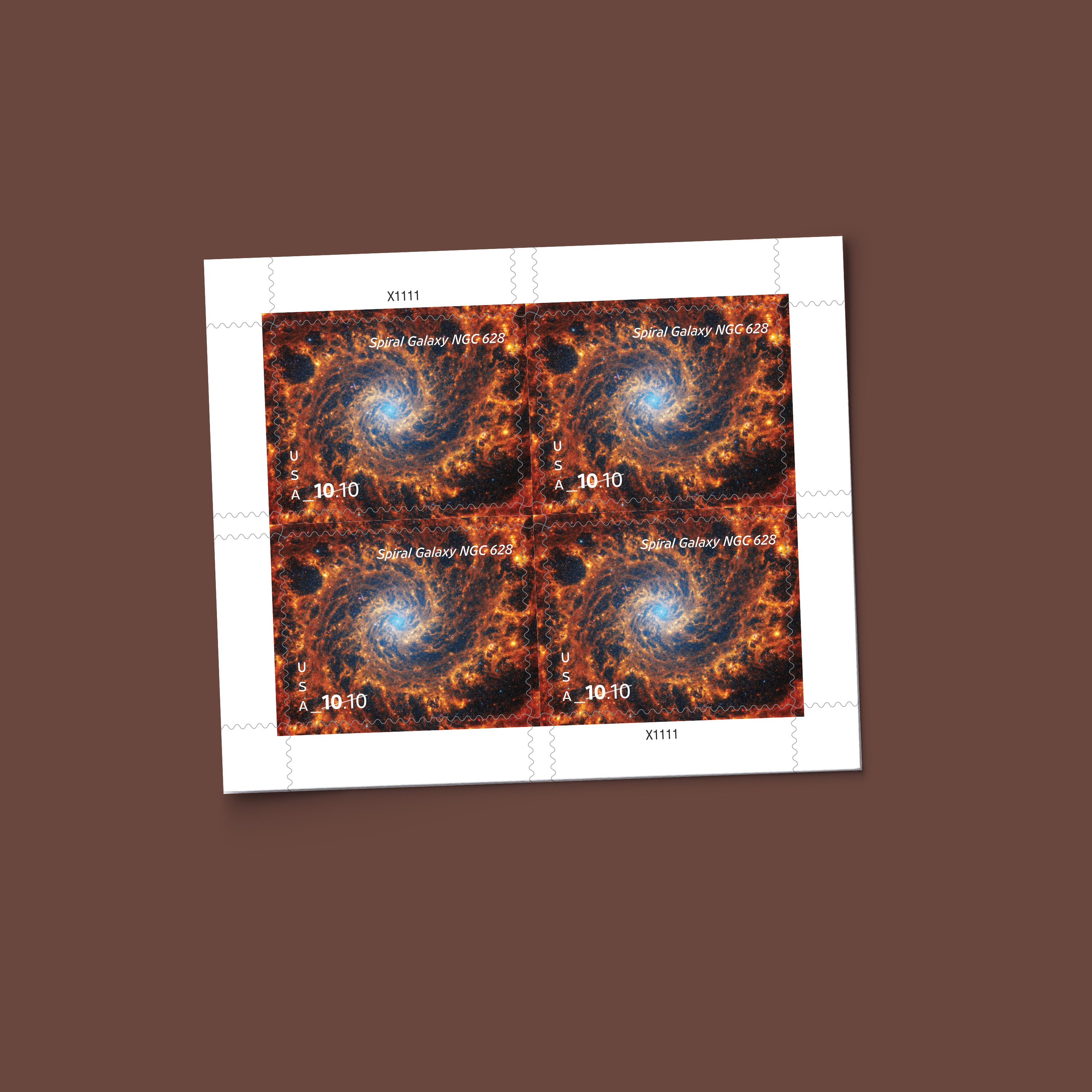
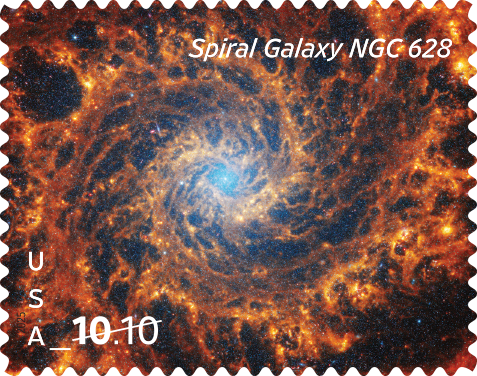
Like a sprawling celestial nautilus, Spiral Galaxy NGC 628, located 32 million light-years from Earth, provides clues to how star formation occurs and galaxies evolve. Captured in crisp detail by the Webb telescope and featured on a 2025 Priority Mail® stamp, this and other images of spiral galaxies help scientists investigate the star formation cycle in galaxies on an unprecedented new scale and provide valuable new clues to the origins of our universe.
The giant spiral arms in the image show extended regions of gas and dust that appear red and orange. Scientists have noted that the structure of this spiral galaxy is repeated elsewhere in the universe, following similar wave patterns.
Janice Lee (STScI), Thomas Williams (University of Oxford), and the PHANGS (Physics at High Angular resolution in Nearby GalaxieS) team contributed to the image.
Star Cluster
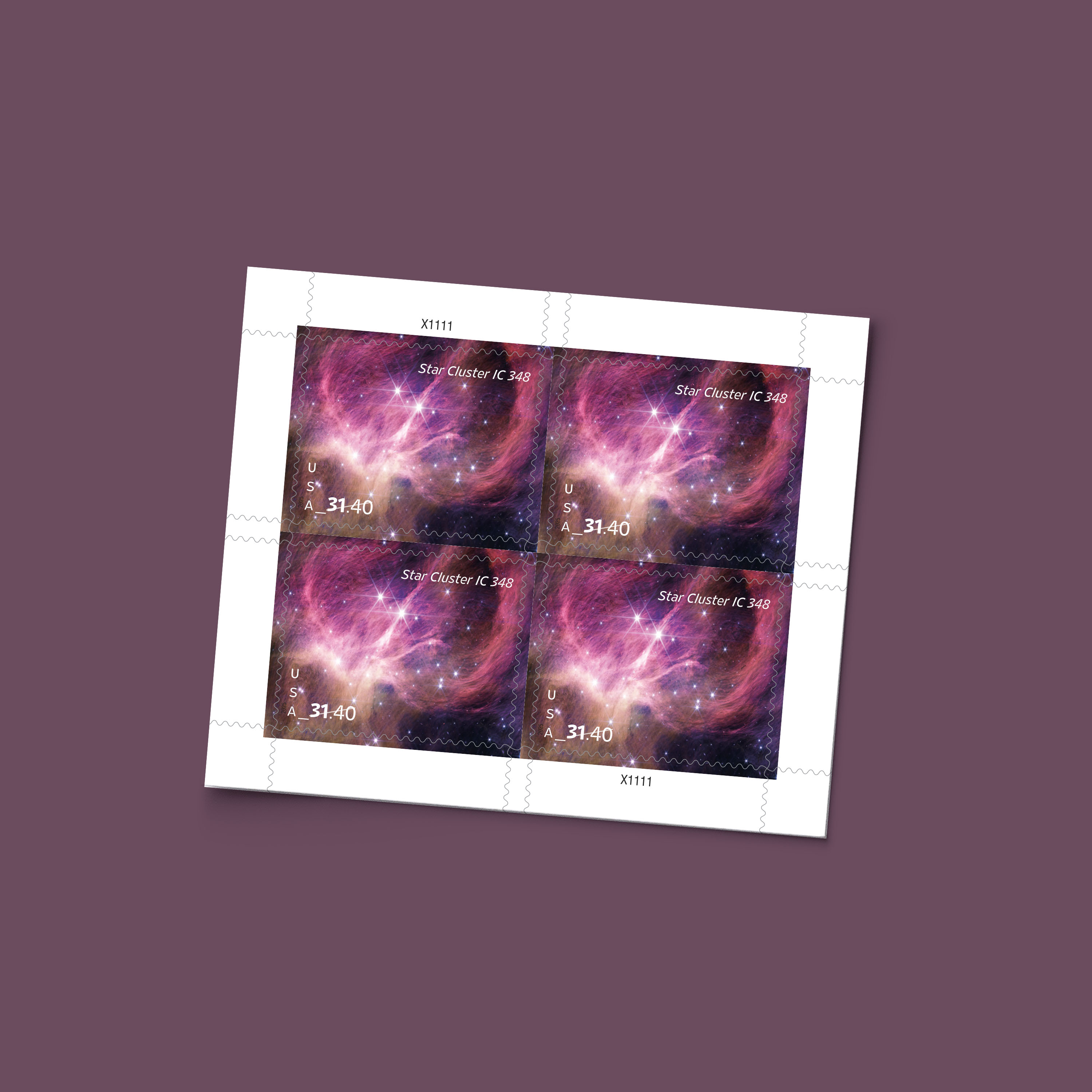
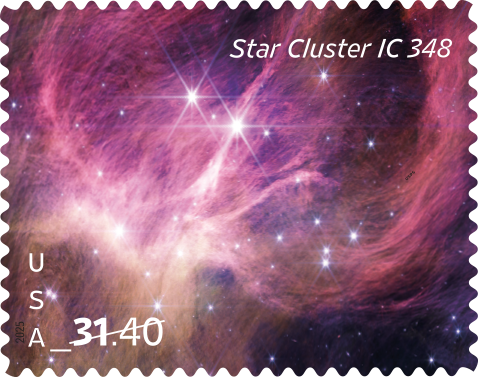
The Star Cluster Priority Mail Express® stamp, also issued in 2025, focuses on star cluster IC 348, a formation approximately 1,000 light-years from Earth within the constellation Perseus.
In the image, stellar material, captured in infrared light by Webb’s filters, cascades like billowing pink, purple, and white curtains while reflecting the light from the cluster’s stars. This is known as a reflection nebula.
Hidden within the cloud of celestial dust are tiny, free-floating brown dwarfs, objects too small to be stars but larger than most planets. Studying these brown dwarfs — each of which is less than eight times the mass of Jupiter — will help scientists explore how star formation processes operate for very small masses.
Because this star cluster is young — only about 5 million years old — the brown dwarfs appear relatively bright in infrared light, glowing from the heat of their formation.
Kevin Luhman (Penn State University) and Catarina Alves de Oliveira (ESA) also contributed to the image.
Crab Nebula
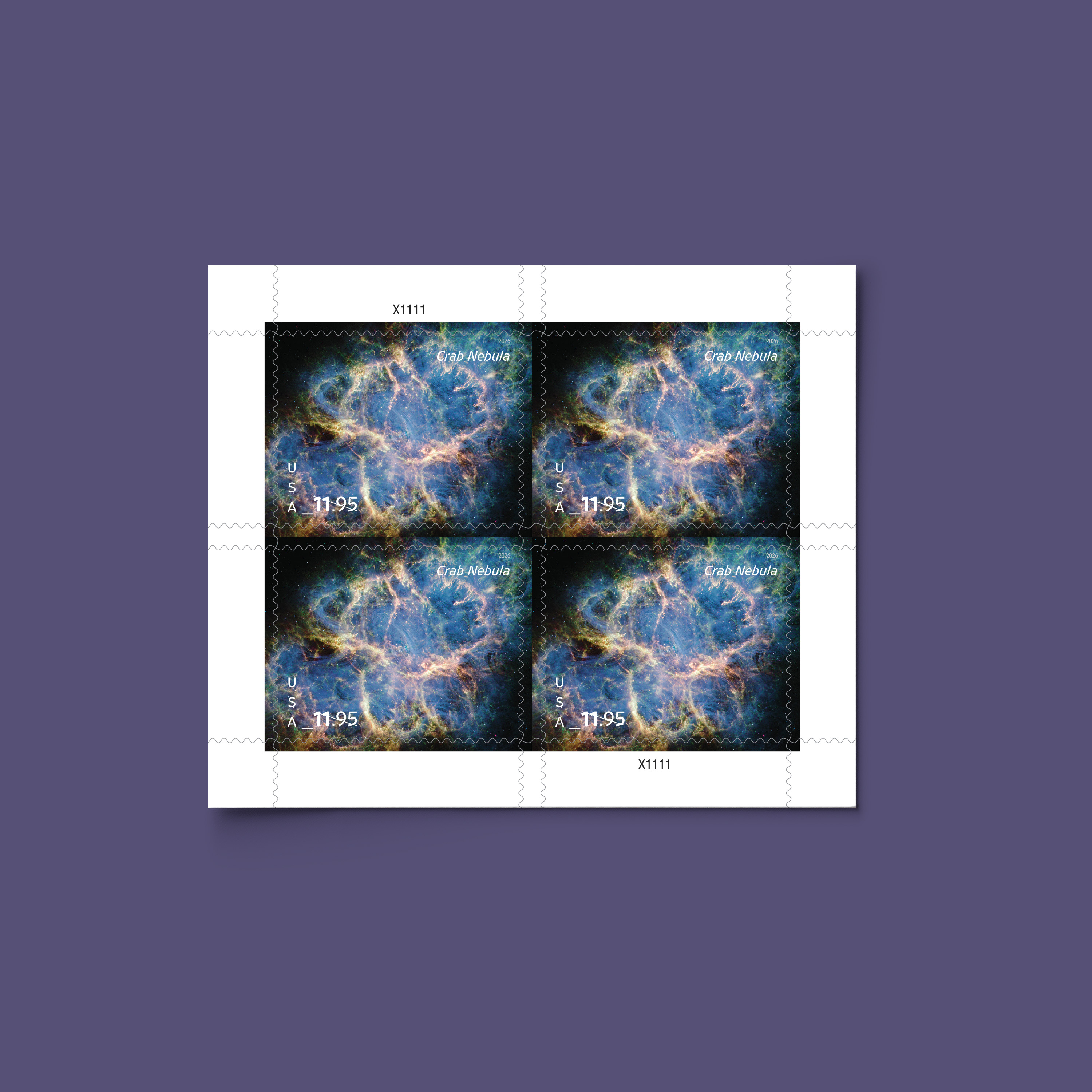
The Crab Nebula, one of the brightest remnants of an exploded star in the night sky, is the subject of a 2026 Priority Mail® stamp. Captured by Webb in 2024, the image offers a fresh perspective on one of the most famous supernova remnants, located 6,500 light-years away in the constellation Taurus.
The star that created the Crab Nebula — also known as Messier 1 (M1) — exploded 6,500 years before it was seen on Earth in 1054. Because it was so bright at the time, the supernova was likely observed by humans all over the world. Its light would have been comparable to the full moon, six times brighter than Venus.
Webb’s infrared instruments were able to document previously unseen details of the nebula’s intricate filaments and glowing clouds. Fluffy magenta dust forms a cage-like shape that stands out in the bottom left and top right areas of the image. This “cage” partly holds in a ghostly blue glow called synchrotron emission, which looks like wisps of smoke. The glow is caused by the Crab Nebula’s central pulsar, a fast-spinning dead star with a strong magnetic field.

Pane of 4
Galaxy Pair
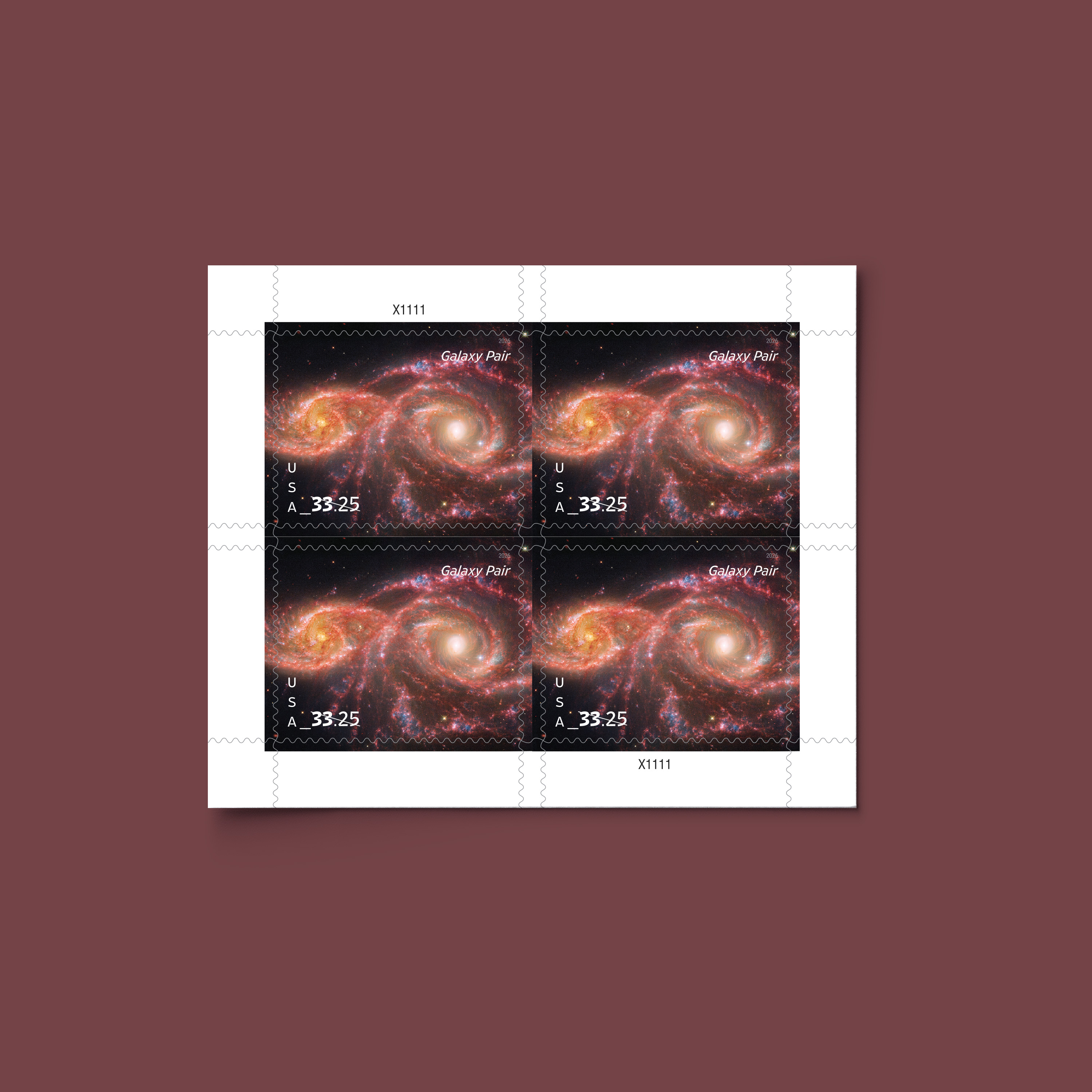
Also in 2026, USPS unveiled the Galaxy Pair Priority Mail Express® stamp, showcasing a stunning view of two interacting galaxies, IC 2163 and NGC 2207, located approximately 80 million light-years from Earth. These galaxies are engaged in a cosmic dance, their mutual gravitational forces distorting their shapes and triggering waves of star formation.
The image is a composite of separate exposures acquired by Webb and its predecessor, the Hubble Space Telescope, launched in 1990. In Hubble’s original image, the star-filled spiral arms glow brightly in blue, and the galaxies’ cores appear in orange. In Webb’s image, cold dust takes center stage, casting the galaxies’ arms in white. Areas where stars are still deeply embedded in the dust appear pink. Other pink regions may be objects that lie well behind these galaxies, including active supermassive black holes known as quasars.

Pane of 4
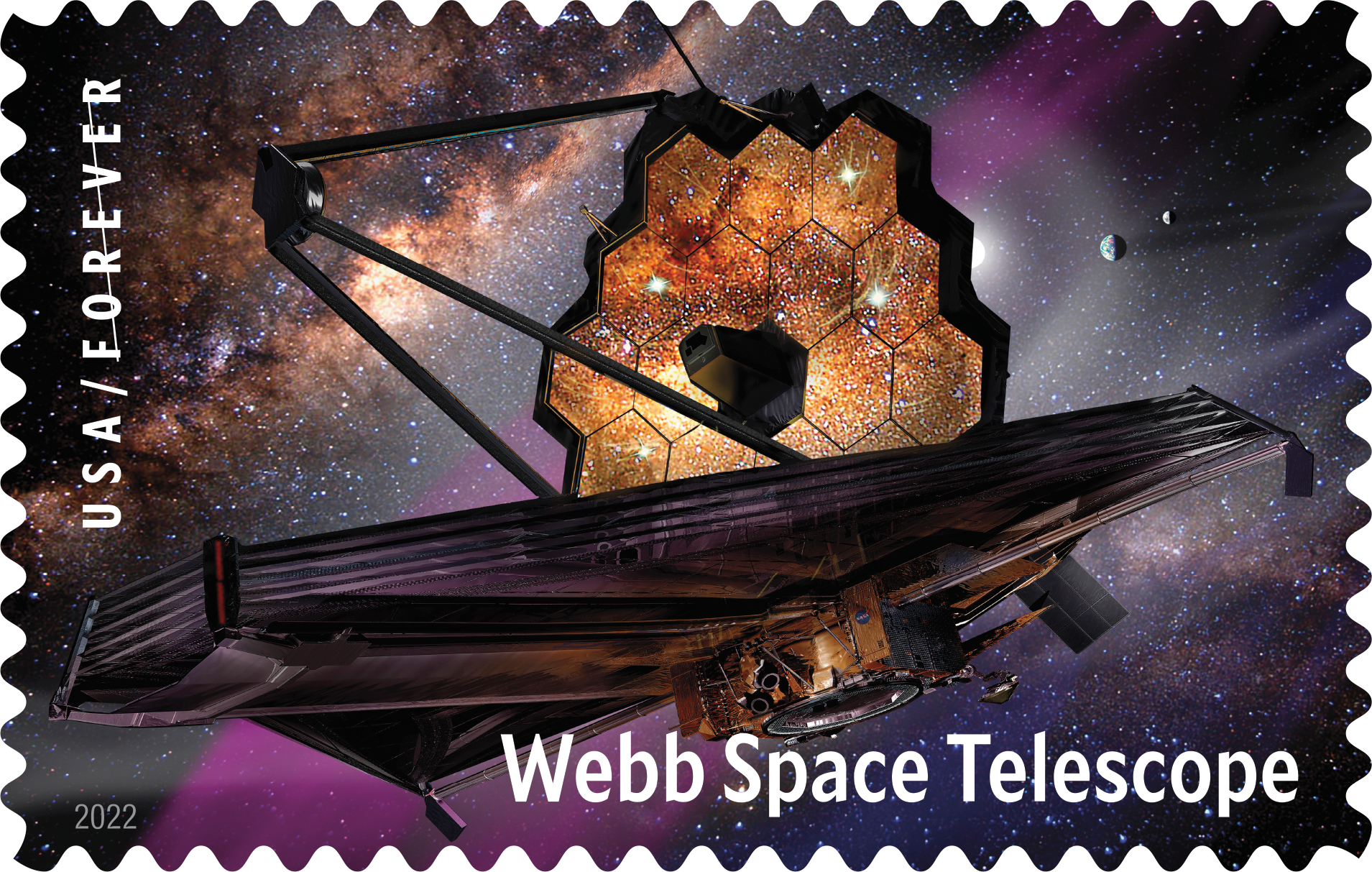
James Webb Space Telescope
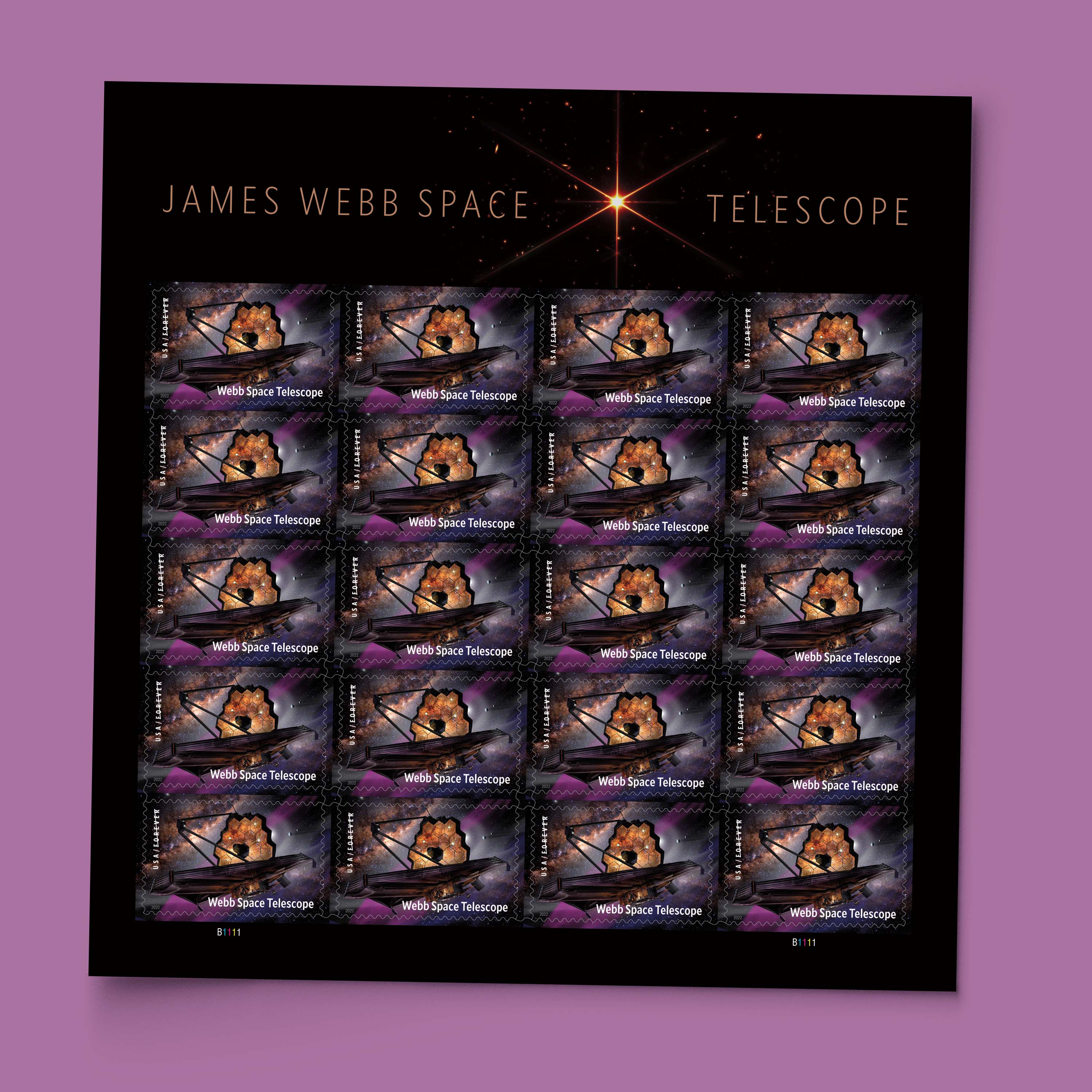
The images on these six stamps truly symbolize both the wonder of space and the power of human innovation. Thus it is fitting that the James Webb Space Telescope was celebrated on its own stamp in 2022, the year after it was launched.
The image on this Forever® stamp is artist James Vaughan’s digitally created depiction of the telescope against a dazzling starscape. Webb’s 18 gold-coated mirror segments — hexagons that combine to form its 21-foot-wide primary mirror — can pick up faint heat waves representing the universe’s first accessible starlight from billions of light-years away. The secondary mirror, supported by three struts, is opposite the primary mirror. Below are Webb’s solar shield, computers, control machinery, and the solar array that provides power.
Derry Noyes, an art director for the Postal Service, was the designer for the stamp project, which also used an image provided by NASA/STScI.
Webb has brought the mysteries of deep space a little closer to home, but USPS has also issued stamps featuring celestial bodies that actually are closer to home and more familiar.
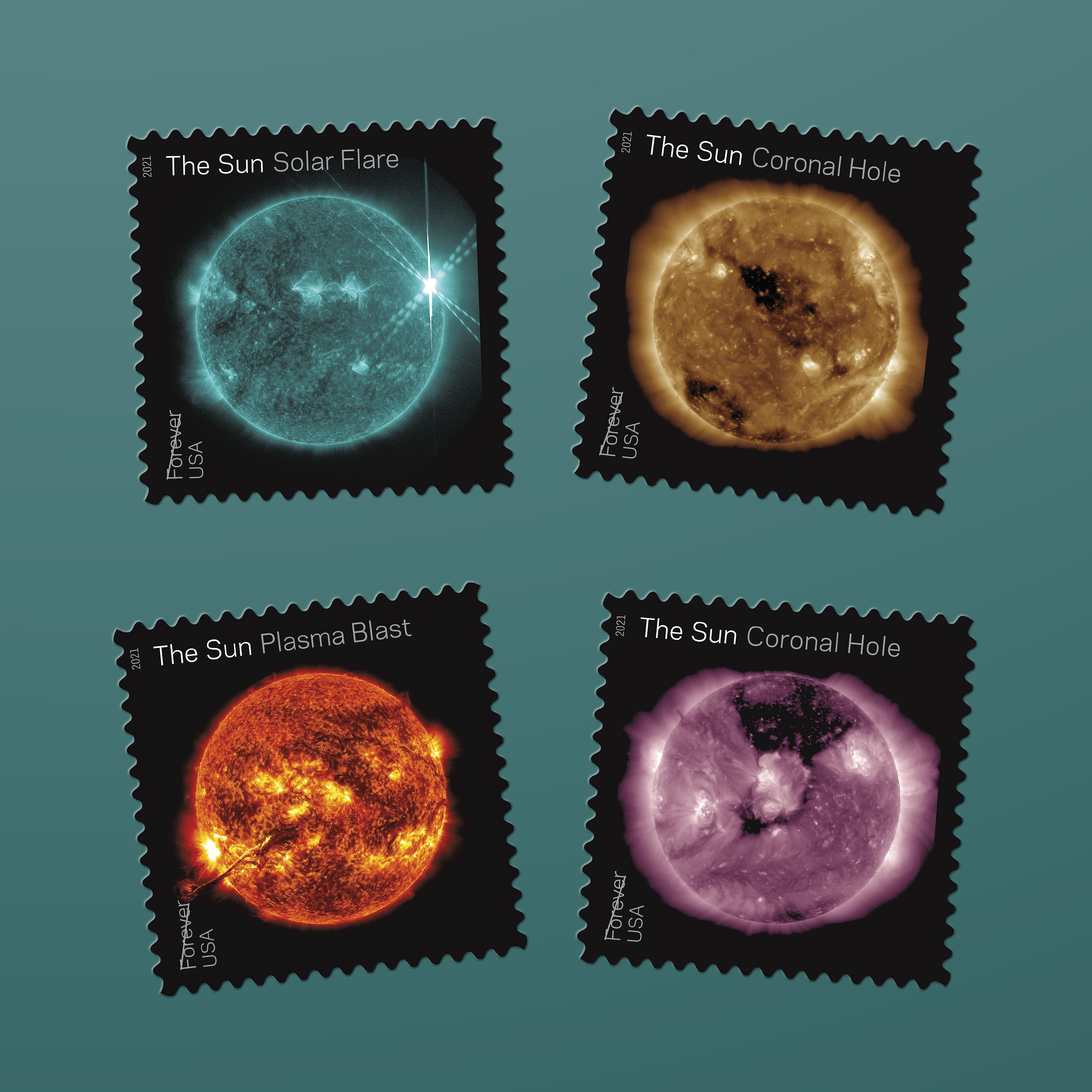
Sun Science
The 2021 Sun Science Forever® stamps feature stunning images of the Sun that celebrate the science behind the ongoing exploration of our nearest star. The images come from NASA’s Solar Dynamics Observatory, a spacecraft launched in February 2010 to keep a constant watch on the Sun from geosynchronous orbit above Earth — its orbit around our planet keeps pace with Earth’s rotation. Each of the images was colorized by NASA according to different wavelengths that reveal or highlight specific features of the Sun’s activity, including sunspots, coronal holes, coronal loops, plasma blasts, and solar flares.
Increased understanding of the Sun helps us better explain and predict its impact not only on Earth’s climate but also on the near-Earth space environment and its impact on sensitive human technology, such as communications systems and satellite electronics.
Antonio Alcalá, an art director for the Postal Service, designed these stamps with images provided by NASA.

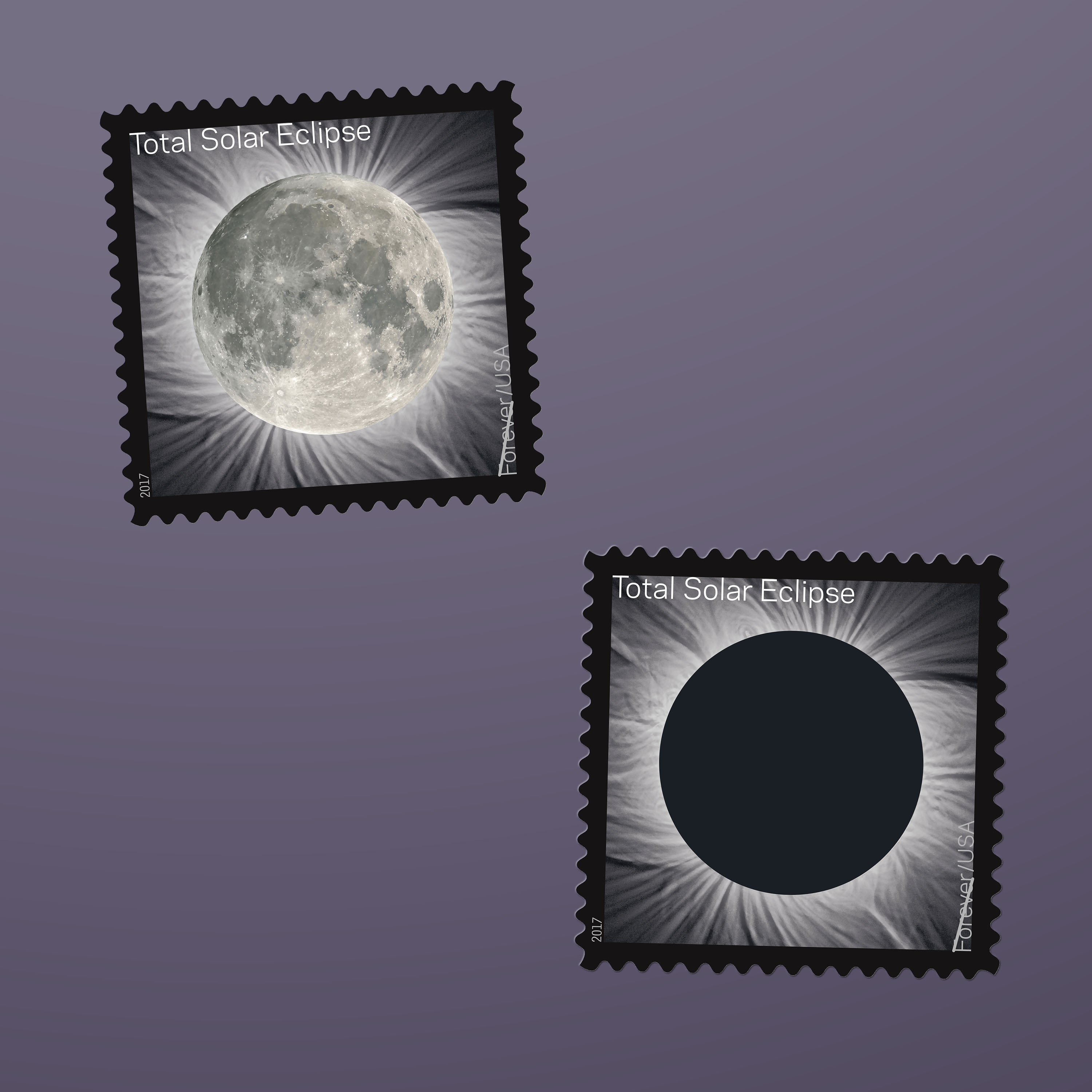
Total Eclipse of the Sun
In 2017 USPS issued the Total Eclipse of the Sun Forever® stamp to celebrate the rare and momentous event viewable by tens of millions of people across the United States on August 21 of that year.
A total eclipse of the Sun occurs when the Moon completely blocks the visible solar disk from view, casting a shadow on Earth. The most recent total solar eclipse seen on the U.S. mainland before 2017 had occurred in 1979, but only in the Northwest. In contrast, the path of totality of the 2017 eclipse was an approximately 70-mile-wide shadow path that traversed the country diagonally during the course of the day, from Oregon to South Carolina.
The stamp uses a photograph taken by astrophysicist Fred Espenak of a total solar eclipse that was seen over Jalu, Libya, on March 29, 2006. This was the first U.S. stamp to use thermochromic ink, which reacts to the heat of your touch. When you place a finger over the black disc on the stamp, the ink changes from black to clear, revealing an image of the Moon. The image reverts to the black disc once it cools.
Antonio Alcalá designed the stamp. The photograph of the Moon was also Espenak’s work.

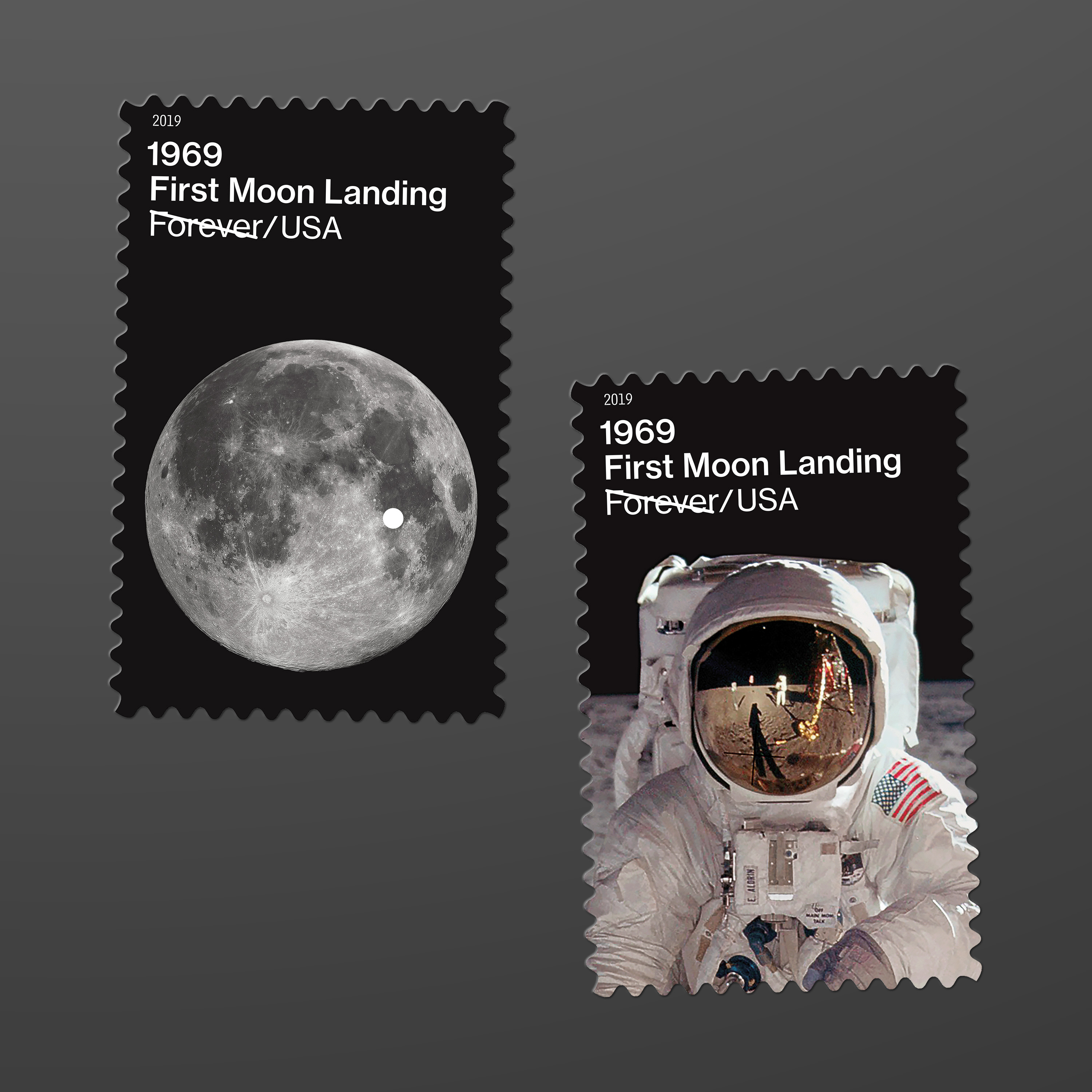
1969: First Moon Landing
On July 20, 1969, Apollo 11 astronauts Neil Armstrong and Buzz Aldrin achieved something that had long been confined to the realm of science fiction when they landed a spidery spacecraft named Eagle on the Moon. A worldwide audience watched and listened when Armstrong stepped onto the Moon’s surface and famously said, “That’s one small step for (a) man, one giant leap for mankind.”
In 2019, on the 50th anniversary of this first Moon landing, two stamp designs commemorated that historic milestone with a pair of Forever® stamps: 1969: First Moon Landing. One features Armstrong’s iconic photograph of Aldrin in his spacesuit on the surface of the Moon. The other, a photograph of the Moon taken in 2010 by Gregory H. Revera from his home in Madison, Alabama, shows the landing site of the Eagle in the Sea of Tranquility. The site is indicated on the stamp by a dot.
After Apollo 11, NASA completed five more Apollo missions through 1972 that landed men on the Moon. The United States remains the only country to have accomplished this remarkable feat.
Antonio Alcalá designed the stamps and the stamp pane.

These are just some of the stamps celebrating our country’s exploration of space. Keep your eyes peeled for upcoming issuances. The possibilities are infinite!