
Phillis Wheatley Stamp Reintroduces a Revolutionary-Era Poet
The 2026 Black Heritage stamp commemorates a colonial-era literary phenomenon just in time for the nation’s 250th anniversary
Since 1978, the Black Heritage series has played an important role in educating the public and sharing accounts of African American excellence. This year’s stamp is an opportunity to reintroduce a remarkable poet from colonial America, one whose writing speaks to the complexity of her times — and whose life story is especially relevant in 2026, as we reflect on the Revolutionary era as part of our nation’s 250th anniversary celebrations.
As an enslaved woman with an education and prominent social connections, Phillis Wheatley (ca 1753–1784) occupied a rare place in colonial America. Born in West Africa and brought to Boston on a slave ship, she was enslaved by merchant John Wheatley and educated in his household. By age 11, she had already begun to compose her own poems. Her 1773 collection, Poems on Various Subjects, Religious and Moral, showcased her mastery of forms ranging from hymns and elegies to philosophical and narrative verse. With its debut, she became the first author of African descent in the American colonies to publish a book.
Wheatley was freed from slavery in 1773, and her later poems reflected growing support for the American Revolution. In late 1775, while George Washington was encamped near British-occupied Boston, Wheatley sent him an ode, published the following year, in which she suggests that the nations of the world are closely watching him to see if a new age in human history is dawning. Washington replied with praise for Wheatley’s poetic talents and extended an invitation to meet if she found herself near his headquarters.
Although Wheatley kept writing, she was unable to publish a second book before her death in her early 30s. Her poetry continued to circulate widely, and her book was reprinted several times in the United States. Before the Civil War, abolitionists republished her work as an argument against slavery. Abolitionists and emancipationists invoked her name and accomplishments to affirm a shared humanity and the intellectual ability of people of African descent.
Her legacy endures today: Schools, libraries, community centers, and university buildings across the country bear her name, and she has inspired numerous children’s books. In 2003, a statue of Wheatley was included in the new Boston Women’s Memorial, all part of an ongoing effort to recognize the poet often praised as “the mother of African American literature.”
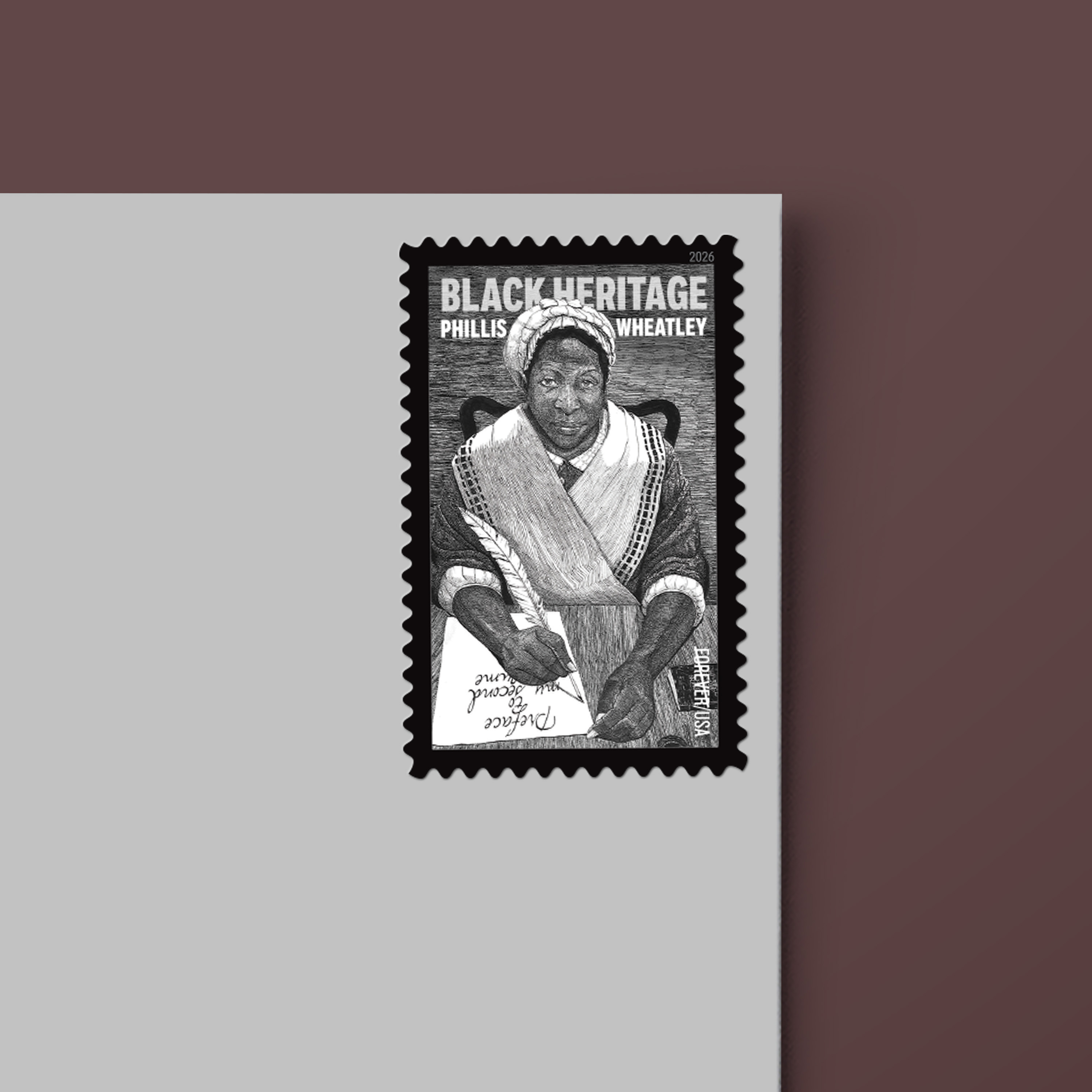
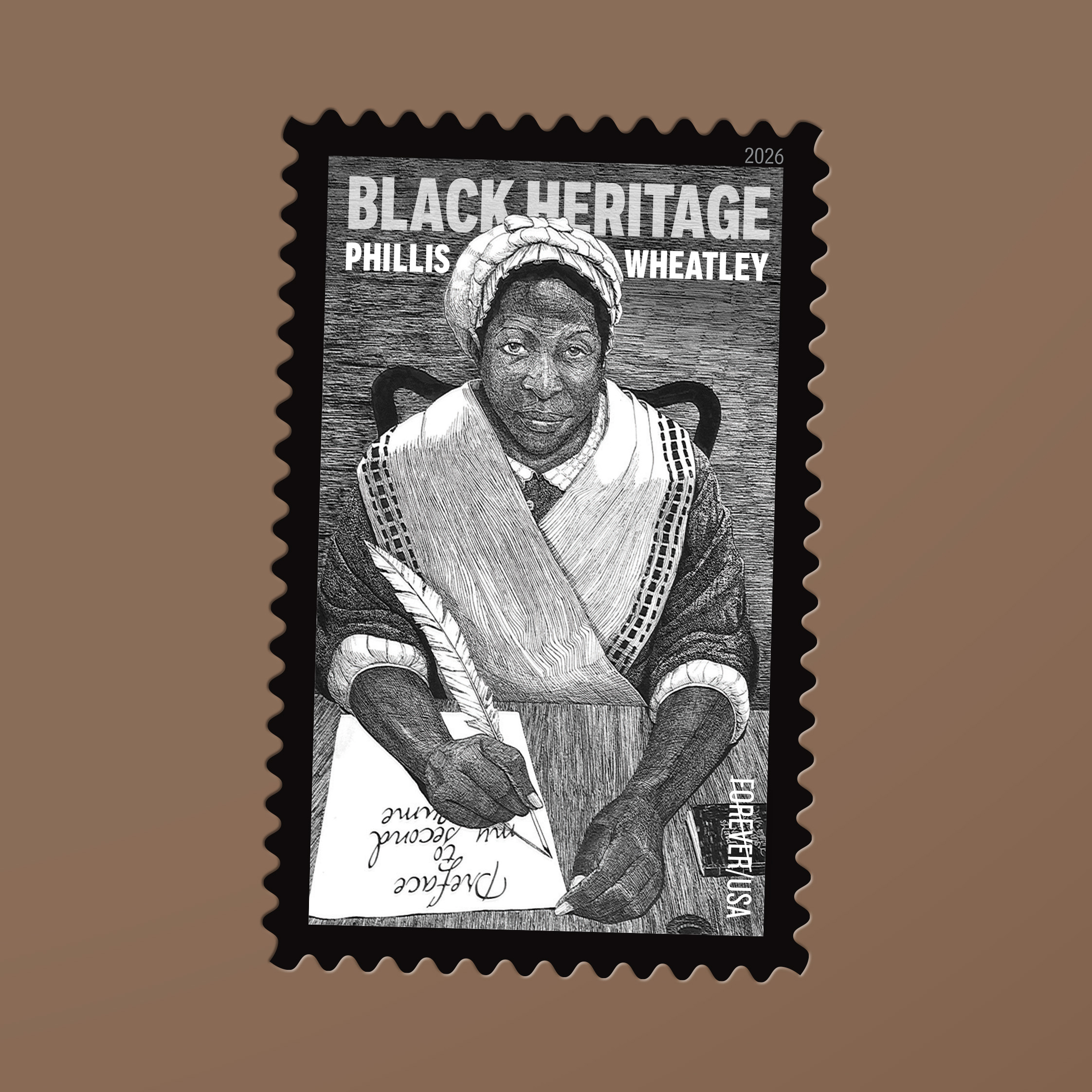
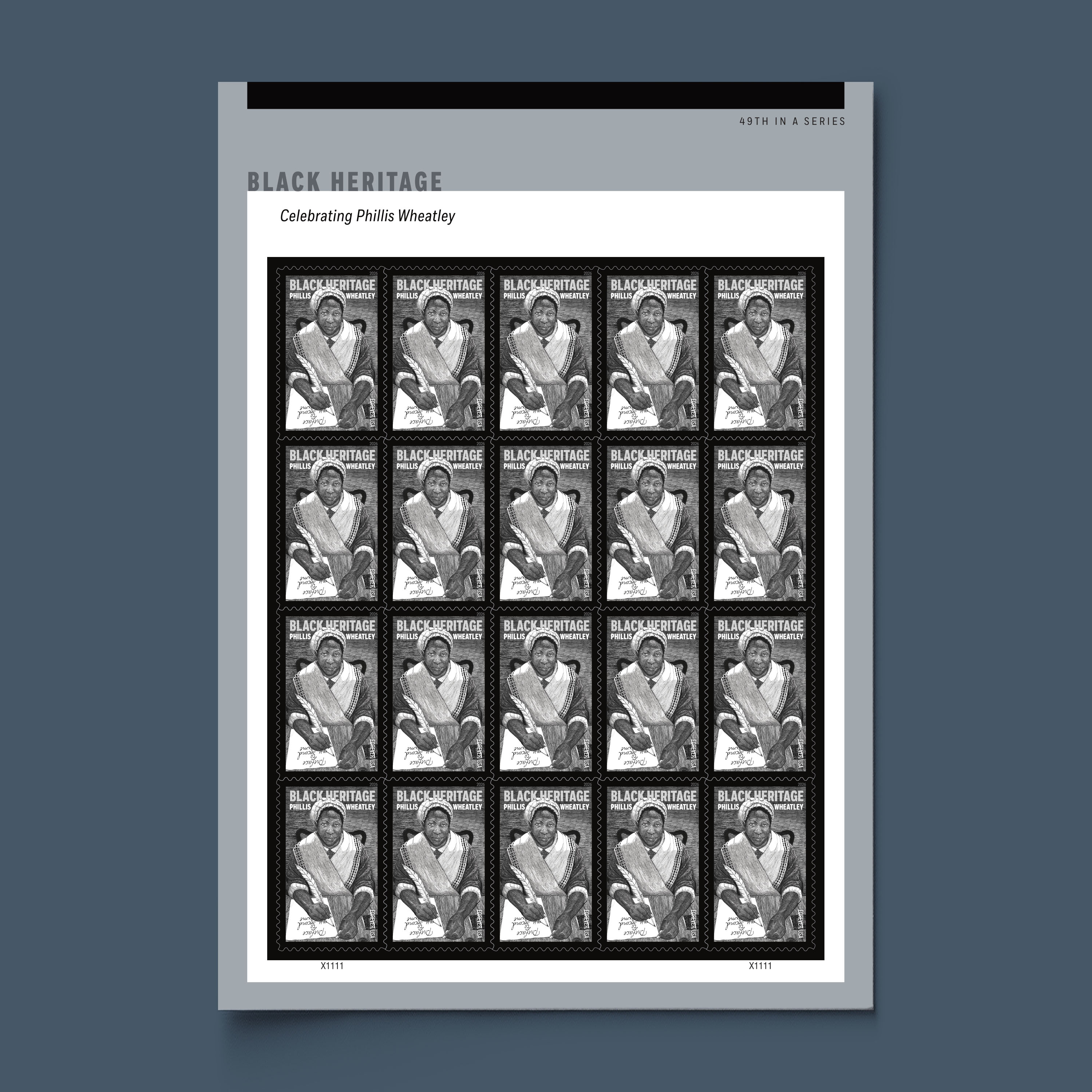
The stamp art features a black-and-white portrait of Wheatley by acclaimed artist Kerry James Marshall, who imagines her later in life, working on her second, unpublished book of poems. Antonio Alcalá served as art director and designer for the stamp. The design recalls the only known portrait made during Wheatley's lifetime, the engraved frontispiece of her 1773 book. While that image shows Wheatley in profile, Marshall presents her looking directly at the viewer, even as she wears similar clothing and sits at the same desk. The style of his ink-on-paper portrait echoes the hatched lines of the original engraving but reinterprets it, depicting Wheatley as confident, assertive, and free.
As a result, this 49th Black Heritage stamp reminds us of the broader story of the Revolutionary era: not only its great promises, but also the figures, like Wheatley, who gave hope that those promises might someday be fulfilled.