
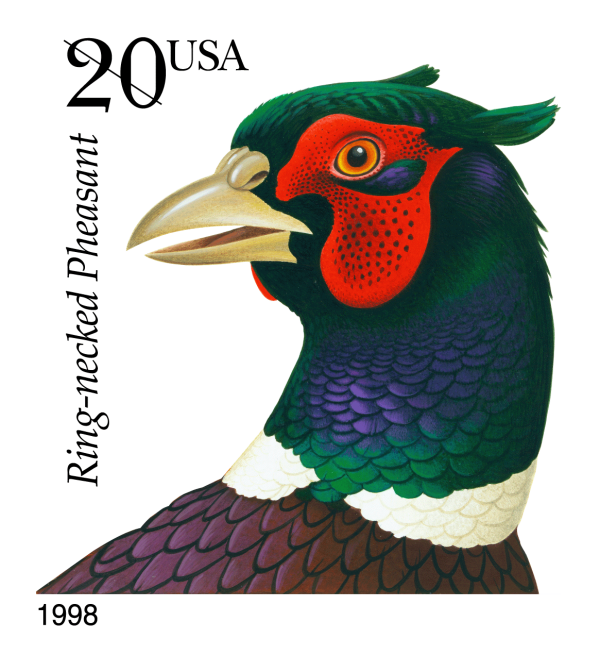
About This Stamp
Two 20-cent multicolored Ring-necked Pheasant definitives were issued on July 31, 1998, at the Americover ’98 stamp show in Somerset, New Jersey. The stamps replaced the 20-cent Blue Jay stamps produced by Stamp Venturers. Two different printers — Bureau of Engraving and Printing and Avery Dennison Security Printing — produced the Ring-necked Pheasant stamps, both using gravure. Robert Giusti designed the stamp.
The yellow, magenta, cyan, and black self-adhesive stamp in a booklet pane of 10 was printed by Avery Dennison Security Printing on a Dai Nippon Kiko 8-color webfed gravure press and die-cut in a serpentine fashion on a Comco Commander rotary die cutter, simulating perforations of 11¼ on three sides. Panes of 10 were distributed, arranged vertically five across by two down. Gravure printing cylinders of 44 panes, two across and 22 down, were used. One set of four gravure cylinder numbers preceded by the letter ‘V’ appears on the top selvage strip in the convertible booklet.
The yellow, magenta, cyan, and black coil stamp was printed on the Bureau of Engraving and Printing seven-color Andreotti gravure press (601) and distributed in vertically perforated rolls of 100. Gravure printing cylinders with 480 subjects were used to print the stamp. One group of four cylinder numbers appears on every 24th. The stamp was perforated 10 on the Goebel rotary die cutter.
In July 1999 the Postal Service began distributing the 20-cent Ring-necked Pheasant definitives in a 10-stamp booklet format for vending machines. Produced by Avery Dennison Security Printing, the new format differs from its previous product in the positioning of the stamps. On the vending booklet, there are four rows of the pheasant facing left, with single stamps at the top and bottom of the pane, the bird facing down. The eight stamps have serpentine die-cut perforations either 10.6 on top and bottom or 10.6 on top and 10.4 on bottom and are perforated on three sides. The top and bottom stamps have serpentine die-cut perforations 10.6 x 10.4 on three sides.
Two previous stamps had depicted the Ring-necked pheasant, the 20-cent South Dakota stamp and the earlier Flora and Fauna 25-cent Pheasant stamp. The Ring-necked pheasant is the official state bird of South Dakota.
The Ring-necked pheasant (Phasianus colchicus) was introduced into North America from Asia and is established over much of the continent, especially in agricultural lands. The adult is about 20–28 inches long, with a wingspan of 22–34 inches, weighing 17.6–106 ounces. The male has a red eye patch, brilliant green head, and (usually) white neck ring and body patterned in soft brown and iridescent russet. The female is a mottled, sandy brown with a shorter tail. Adults feed on berries, seeds, buds, and leaves.
Stamp Art Director

Derry Noyes
For more than 40 years Derry Noyes has designed and provided art direction for close to 800 United States postage stamps and stamp products. She holds a bachelor of arts degree from Hampshire College and a master of fine arts degree from Yale University.
Noyes worked as a graphics designer at Beveridge and Associates, a Washington, D.C., firm, until 1979 when she established her own design firm, Derry Noyes Graphics. Her clients have included museums, corporations, foundations, and architectural and educational institutions. Her work has been honored by American Illustration, the Art Directors Club of Metropolitan Washington, Communication Arts, Critique magazine, Graphis, Creativity International, and the Society of Illustrators.
Before becoming an art director for the U.S. Postal Service, she served as a member of the Citizens' Stamp Advisory Committee from 1981 to 1983.
Noyes is a resident of Washington, D.C.
Stamp Artist

Robert Giusti
Born in Switzerland and raised in New York City, Robert Giusti studied painting, sculpture, and graphics at the Tyler School of Fine Arts in Philadelphia and Cranbrook Academy of Art in Michigan. The son of a graphic designer, Giusti grew up in an environment where expression of creativity was highly encouraged — the perfect atmosphere for a budding artist.
Giusti returned to New York after finishing school, finding success in the art world there. He began to work in advertising and publishing before setting out as a freelance illustrator and designer, gaining acclaim for his unique style. Some of the clients he has worked with throughout his career include United Airlines, Columbia Records, The New York Times, ExxonMobil, NBC, and TIME.
Since childhood, Giusti has had a fascination with animals, enamored with their simple, honest beauty that lends itself to imaginative recreations. His portfolio of stamps created for the U.S. Postal Service features an array of colorful wildlife. His love for abstract paintings and concepts has remained steadfast through the years.
Currently, Giusti is illustrating covers for Der Spiegel magazine, as well as their children's publications. His work has been exhibited in galleries and museums around the world, winning him silver and gold medals from the Society of Illustrators, among many others.
Giusti lives in Bridgewater, Connecticut, with his wife, Grace, and their two dogs, Lupo and Baci. Songbirds in Snow (2016), Songbirds (2014), and Tufted Puffins (2013) are his most recent projects for the Postal Service. Other designs by Giusti include Cardinal (1991), Wild Animals (1992), Tropical Birds (1998), and Red Fox (1999).