
About This Stamp
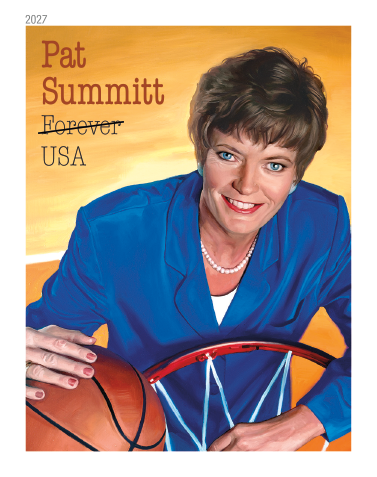
Basketball coach Pat Summitt (1952–2016) didn’t just win games. She changed the trajectory of women’s sports. In her 38 seasons at the University of Tennessee, she built the Lady Volunteers into one of the most successful dynasties in college athletics, finishing her career with 1,098 victories and eight national championships.
Demanding, disciplined, and fiercely competitive, Summitt pushed her players to excel on and off the court. Every Lady Vol who played four years under her graduated, and dozens went on to become coaches themselves. Her success helped elevate women’s basketball nationally while raising expectations for how women athletes and their coaches should be supported.
Although she was diagnosed with early onset dementia, Alzheimer’s type, in 2011, Summitt continued coaching for one final season before retiring in April 2012. Soon after her diagnosis, she formed the Pat Summitt Foundation to support Alzheimer’s research, patient care, and education. In 2012, she received the Presidential Medal of Freedom, the nation’s highest civilian honor.
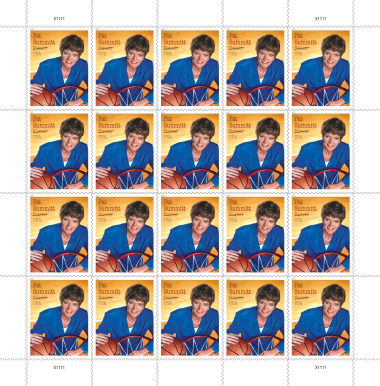
Stamp artist Roberto Parada based his portrait on a photograph taken by John Madere for the cover of Summitt’s 1998 book Reach for the Summitt, co-written with Sally Jenkins. Set against a basketball court background, the portrait shows Summitt holding a basketball while leaning over a basketball hoop.
Working in oil on primed linen, Parada aimed to capture not only Summitt’s likeness but also the force of her personality. “She had such a commanding look,” he says, “a big presence.” His appreciation for her achievements only deepened as he worked. “It’s hard to reach the mountain top,” he says, “and to have done it as many times as she did is pretty incredible.”
The Pat Summitt stamp is being issued as a Forever® stamp. This Forever stamp will always be equal to the current First-Class Mail® one-ounce price.
Stamp Art Director, Stamp Designer
Ethel Kessler
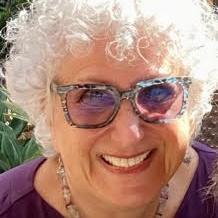
Ethel Kessler is an award-winning designer and art director who has worked with corporations, museums, public and private institutions, professional service organizations, and now, the United States Postal Service.
After earning a B.F.A. in visual communications from the Maryland Institute College of Art, Kessler worked as a graphic designer and project manager for the exhibits division of the United States Information Agency. Her work was distributed internationally on subjects such as Immigration, Entrepreneurship, Renovation of American Cities, and the Bicentennial of 1976. She was also responsible for exhibits in Morocco, Botswana, and El Salvador.
In 1981, she established Kessler Design, Inc., for which she is creative director and designer. Clients have included the Clinton Government reorganization, the Smithsonian Institution, National Geographic Television, the National Park Service, and the American Institute of Architects.
She has been an art director for the U.S. Postal Service’s stamp development program for more than 25 years. As an art director for USPS, Kessler has been responsible for creating more than 500 stamp designs, including the Breast Cancer Research stamp illustrated by Whitney Sherman. Issued in 1998, the stamp is still on sale and has raised more $98 million for breast cancer research. Other Kessler projects include the popular and highly regarded Nature of America 120 stamp series, a collaboration with nationally acclaimed nature illustrator John Dawson, the 12-year Lunar New Year series with Kam Mak, the American Filmmaking: Behind the Scenes 10 stamps issued in 2003, a 2016 pane of stamps celebrating the 100th anniversary of the National Park Service, and the 2023 stamp honoring Supreme Court Associate Justice Ruth Bader Ginsburg. And many, many others.
Stamp Artist

Roberto Parada
Born and raised in suburban North Arlington, New Jersey, Roberto Parada attended Pratt Institute in Brooklyn. Upon his 1991 graduation, he began to accept illustration commissions from high-profile magazines.
Parada soon developed his distinctive style — undeniably modern but grounded in painterly techniques of the old masters, Degas and Rembrandt in particular, as well as modern masters such as Andrew Wyeth. Parada works mainly in oils using methods that would be familiar to those predecessors. He stretches his own canvases with tacks, uses an old-school crank easel, and holds his paints on a wooden palette. He then sends clients digital photographs of his paintings as they dry, enabling quick turnaround on tight editorial deadlines. He favors nontoxic art supplies and advocates for their use.
Parada is particularly known for distinctive editorial portraits that offer his satirical spin on people and events in popular culture. Although akin to editorial cartoons, these works are rendered realistically in a fresh, modern style. He has depicted presidents, actors, athletes, and business leaders with insight and, when the occasion calls for it, great wit. One of his most famous works is a naturalistic imagining of Homer Simpson, commissioned for an Esquire magazine article about how television’s cartoon families often reflect society more honestly than flesh-and-blood sitcoms.
Roberto Parada’s editorial illustrations have appeared in Time, Newsweek, Rolling Stone, Entertainment Weekly, Sports Illustrated, and numerous other publications. He lives and works in Brooklyn, New York.
His first stamp projects were portraits of Alexander Hamilton and Paul Revere for the 2026 Figures of the American Revolution stamp pane.