
About This Stamp
Strange creatures lurk all over America. Whether they’re hiding within our vast wilderness or simply populating the recesses of our wild imaginations, fantastical beasts reflect our curiosity about the unknown — and our love of a good mystery.
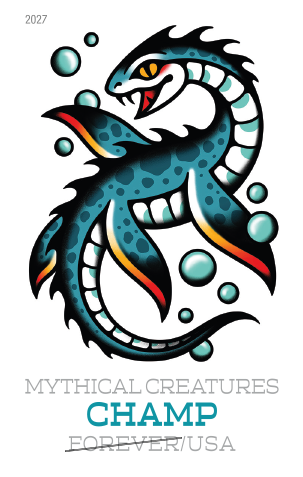
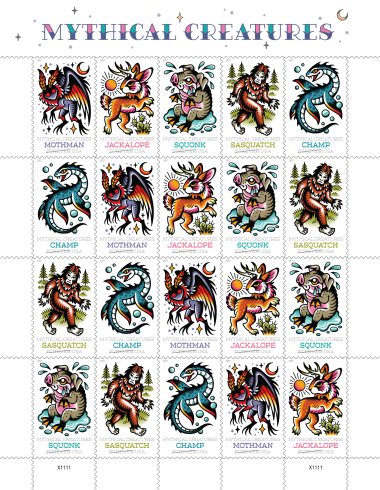
With these Mythical Creatures stamps, the U.S. Postal Service captures five folkloric animals — Mothman, Jackalope, Squonk, Sasquatch, and Champ — on a pane of 20 stamps. Though these creatures are rarely spotted in the wild, the stamp artwork’s bold lines and vivid colors bring them to life in the style of tattoo art, where these beings are often encountered.
A hazy line divides folklore, regional tales passed through generations, and cryptozoology, the study and pursuit of unverified species. The stamps feature a variety of mythical creatures, a term that embraces both categories. Countless other such beings populate the nation’s mythology. Though elusive, each one reveals aspects of the lore and landscape of its local origins.
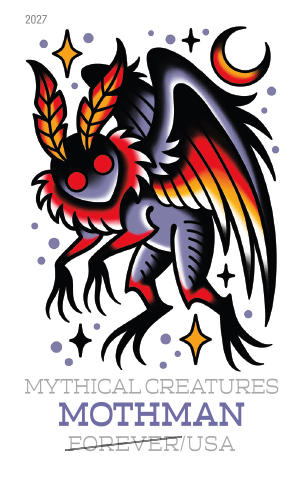
The legend of Mothman has endured for more than six decades, but of the creatures encountered on these stamps, this flying, man-sized, red-eyed being emerged the most recently. The cryptid was first reported in West Virginia in 1966. Several nights after a gravedigger reported a winged, human-sized creature swooping above, two couples on a midnight drive in the rural outskirts of Point Pleasant reported being chased from overhead at great speed as they fled back to town. Newspapers dubbed the creature “Mothman.” After a year of eerie sightings was followed by a local tragedy, some interpreted the appearances as harbingers of disaster. In the years since, a lighter side of Mothman has been embraced by festival attendees, many in “spooky-cute” costumes that evoke this increasingly popular cryptid.
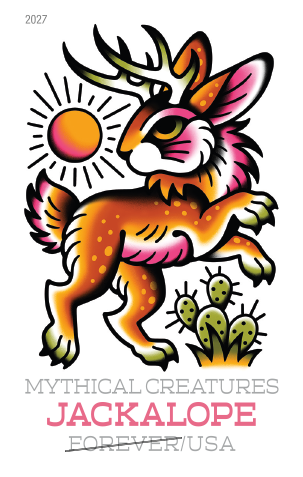
Unlike most of the creatures on these stamps, the Jackalope has been spotted by a great many Americans. It has multiplied rapidly, especially in the West, since first appearing in the 1930s in Douglas, Wyoming. This antlered rabbit was the creation of two young brothers studying taxidermy by mail who, in a moment of inspiration after a hunting trip, crafted the hoax. When the masterful mashup was displayed at a local inn, the Jackalope quickly sprang into regional folklore. Today, Jackalopes are found in gift shops in the Great Plains and Western states — on postcards, stickers, and T-shirts, and as plush toys and mounted specimens. The fanciful hybrid endlessly inspires the imaginations of those who encounter it, and who add to its lore with their own stories, songs, and artworks.
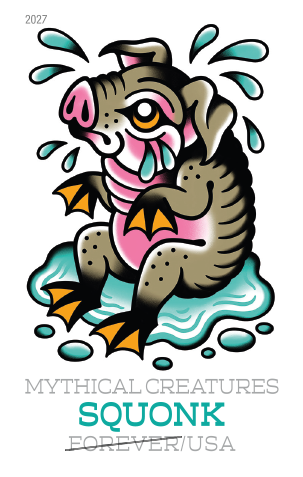
The Squonk hides away in northern Pennsylvania’s dense hemlock forests, so distressed by its own appearance that it cries constantly. This piglike animal, wrinkled, blemished, and self-conscious, was first described in print in a 1910 collection of lumberjack folklore, Fearsome Creatures of the Lumberwoods. The book — recounting tales often spun and re-spun by the fireside in remote logging encampments of the 19th and early 20th centuries — relates an episode of a Squonk captured in a bag: As the hunter carried his prey, its weeping faded and the sack grew lighter. Investigation revealed that the Squonk had melted into “nothing but tears and bubbles.” In recent years, the melancholy character has been revived as a darling mascot of introverts and anyone else who relates to the Squonk’s social anxiety.
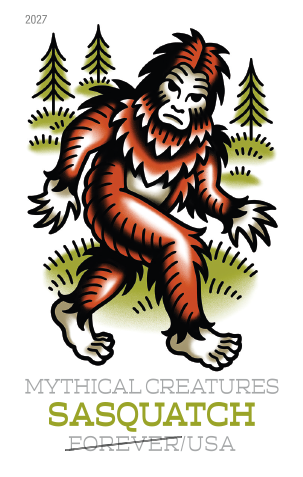
Sasquatch captures the American imagination like no other cryptid. Nobody, though, has captured Bigfoot, as this large hairy hominid is commonly called, nor even retrieved a confirmed strand of hair from its notoriously stinky, shaggy fur. In the Pacific Northwest, ancient Indigenous tales of mysterious, hairy humanoids encouraged caution in the wild and mindful custodianship of forest habitat. By the late 20th century, reported sightings of Sasquatch and similar regional creatures had taken hold and spanned the nation. In fact, tales of huge bipeds are told worldwide, almost anywhere shadowy terrain could conceivably conceal such elusive beings. Hoaxes abound, including blurry films and casts of outsized human-like footprints, but the most notable impression Sasquatch makes is its lasting mark on American popular culture. Even if our most famous mythical creature is nowhere to be found, Sasquatch is everywhere.
Champ, as the Lake Champlain monster is affectionately known, is said to dwell within the nation’s sixth largest lake, which defines more than 100 miles of the New York–Vermont border. A glacial lake reaching 400 feet deep and 14 miles wide is bound to contain mysteries — over the last few centuries, hundreds have claimed to see the serpentine organism. Cryptozoologists have tried to determine what it could be: perhaps a descendant of an aquatic, dinosaur-era reptile or whale, as found in fossils? Skeptics point to more mundane possibilities: sturgeon and other large fish that inhabit the lake, swimming deer, waves, mirages, and tree trunks riding currents. While a living specimen has proven elusive, Champ is ever-present as a beloved mascot of the region, celebrated in business logos, and in festivals and museum exhibits.
America loves its mythical creatures. Their lore grows through songs and artworks, movies, TV shows, and video games. Celebrating these fanciful fauna with festivals provides a boon to small-town economies and fosters communities of enthusiasts.
Dragons of myth have been celebrated on the nation’s postage stamps: Foil-embossed dragon designs graced an issuance in 2018; Year of the Dragon stamps were issued in 2000, 2012, and 2024 to commemorate Lunar New Year; 2024 Dungeons & Dragons stamps also featured the fantastical creatures.
Are mythical creatures hiding in the natural environment, awaiting discovery? Or are they lingering in more supernatural spaces, or maybe just helping us indulge our sillier side? Whatever the case, fantastical beings tickle our appetite for the thrill of adventure and discovery — reminders that there are still corners of the natural environment that remain in the shadows.
Stamp Art Director

Antonio Alcalá
Antonio Alcalá served on the Postmaster General’s Citizens' Stamp Advisory Committee from 2010 until 2011, when he left to become an art director for the U.S. Postal Service's stamp development program.
He is founder and co-owner of Studio A, a design practice working with museums and arts institutions. His clients include: the National Gallery of Art, Library of Congress, National Portrait Gallery, National Museum of Women in the Arts, The Phillips Collection, and Smithsonian Institution. He also lectures at colleges including the Corcoran College of Art + Design, SVA, Pratt, and MICA.
In 2008, his work and contributions to the field of graphic design were recognized with his selection as an AIGA Fellow. He has judged international competitions for the Society of Illustrators, American Illustration, AIGA, and Graphis. Alcalá also serves on the Smithsonian National Postal Museum and Poster House Museum’s advisory councils. His designs are represented in the AIGA Design Archives, the National Postal Museum, and the Library of Congress Permanent Collection of Graphic Design.
Alcalá graduated from Yale University with a BA in history and from the Yale School of Art with an MFA in graphic design. He lives with his wife in Alexandria, Virginia.
Stamp Artist

Nat Power
Nat Power is a tattooer based in Austin, Texas. Raised in the North Texas city of Cedar Hill, she later relocated to Austin to earn a Bachelor of Fine Arts degree in studio art at the University of Texas in 2016. Her study of printmaking and painting came to inform her approach to tattooing; she pulls from the bold and bright techniques she enjoyed in serigraphy to create tattoo designs of a similar structure.
Power began her tattoo apprenticeship in 2019 at Royal Legion Tattoo, where she continues as a resident artist. Trained with an American traditional approach to tattooing, she prioritizes strong shape and vibrant color to create concise designs. Her work takes a playful approach to the canon of traditional tattoo design, while continuing to employ foundations of the style and ensure that each tattoo carries classic American traditional elements.
Power’s tattoos and paintings frequently feature animals as a primary focus. Her depictions range from the ordinary to the unusual, and often explore folkloric fauna and strange chimerical beings.
Mythical Creatures (2027) is her first stamp project for the U.S. Postal Service.